Home › Mine-site component cleaning
Cleaning guide · mining maintenanceMechanical maintenance contractors and mine plant workshops keep haul trucks, loaders, drills and pumps running. Components come off the machines caked in oil, grease, dust and mud. This guide explains how to clean them faster and more consistently, and which machine suits which component.
On a mine, a component that comes into the workshop is often thick with a mix of oil, grease and fine dust that has baked into a paste. Before a fitter can inspect a pump, rebuild a final drive or measure a gearbox shaft, that layer has to go. If cleaning is slow, the bottleneck moves from the repair to the wash bay. If it is inconsistent, wear and cracks can be missed and grit can find its way into a rebuilt component.
Maintenance contractors also work to agreed turnaround times and often to the mine’s safety and environmental rules, which makes open solvent or diesel tubs and long hand-scrubbing sessions harder to justify.
A wash bay or pressure washer is the right first step for removing mud and loose dirt from whole machines and large assemblies. It is less suited to stripped components: it is labour-intensive, wet, and does not reach every face of a part evenly.
Familiar and cheap, but slow, dependent on the person scrubbing, and it brings fumes, skin contact and fire load into the workshop.
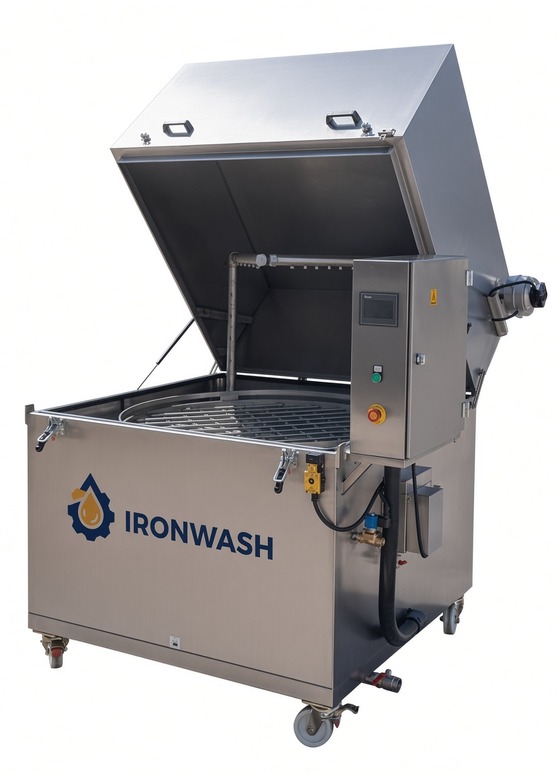
The component goes into a closed cabinet. Heated water-based detergent is sprayed from two spray lines while the basket turns, so every side is degreased while the fitter does other work. A disc oil separator skims oil off the bath, and filters under the basket catch chips and grit. See the Rotor parts washers.
For hydraulic valve bodies, injectors and parts with fine passages, an ultrasonic tank cleans every wetted surface, inside and out. The Sonic range uses a pneumatic platform to lower, agitate and lift the load, with a recirculating 5-micron filter and oil decanting.
Start with the largest component you clean regularly and its weight. The Rotor baskets are Ø740 × 450 mm (150 kg), Ø940 × 500 mm (300 kg) and Ø1140 × 600 mm (400 kg); for larger parts ask about the Rotor 1400. The Rotor 1000 and 1200 include a steam extractor, a delayed-opening door lock and an insulated tank, and the Rotor 1200 has an optional loading trolley and pneumatic lid opening for heavy loads.
Check the site services: Rotor machines need 400 V three-phase with neutral and earth (other voltages on request) and 6–8 bar compressed air. Wheels make it possible to reposition the machine inside the workshop.
For contractors running several sites, a common setup is a Rotor at each main workshop plus a Sonic where fuel-system and hydraulic work is done.
Water-based cleaning still produces oily waste. The oil separator (Rotor) or oil decanting (Sonic) and the filtration extend the time between bath changes. When the bath is spent, pump it into an IBC and have it collected by a licensed waste contractor, in line with the mine’s environmental procedures.
Request a quote, or simply register your interest: it helps us plan the next shipment and costs you nothing.
For heavy, oily drivetrain and engine components an automatic rotary hot-water parts washer does the bulk degreasing. Hydraulic valve bodies, injectors and parts with internal passages are better cleaned in an ultrasonic tank.
A heated water-based spray softens and removes oil and grease that binds dust. Very heavy mud is best knocked off in the wash bay first, then the stripped component goes into the parts washer.
Rotor machines need 400 V three-phase with neutral and earth (other voltages on request) and 6–8 bar compressed air. The Sonic 160X runs on 400 V three-phase; supply details for the Sonic 160 and 310 are confirmed on your quote.
The oil separator or oil decanting and the filters keep the bath working longer. Spent solution is pumped into an IBC and collected by a licensed waste contractor.
Yes, enquiries from across Africa are welcome. Tell us the destination on the quote form; delivery is quoted for each site.
Tell us what you clean and where the machine is going, and we will reply with an itemised quote. Not ready to buy? Tick "register interest" and we will keep you updated on availability and shipments. All enquiries are handled by email: you can also write to info@ironwash.africa.
Enter your email address to unlock the PDF download.