Home › Carbon removal & injectors
Cleaning guide · carbon, injectors, carburettorsCarbon is the hardest deposit most workshops deal with: baked onto pistons, valves, combustion chambers, turbo and exhaust-side parts, injectors and carburettors. Here is how to remove it without damaging the part, and where ultrasonic cleaning fits.
Carbon forms when fuel and oil burn incompletely and the residue bakes onto hot metal. Layer after layer, it becomes hard, sometimes glassy, and bonds tightly to the surface. It builds up on piston crowns and ring grooves, valve heads and stems, combustion chambers, EGR and inlet parts, turbo housings and injector tips. In carburettors and fuel-system parts, old fuel leaves varnish and gum in tiny jets and passages.
Because carbon is not oily, a degreaser on its own does little. It needs time in a hot, suitable chemistry and strong mechanical action, or abrasive removal.
Effective on accessible flat surfaces, but slow, and easy to scratch gasket faces, aluminium and precision surfaces. It cannot reach inside passages.
Chemical soaks soften carbon, but often need long times and still leave scrubbing to do. Some strong chemicals attack aluminium, rubber or coatings, so check compatibility.
Media blasting removes carbon quickly from some surfaces, but media can lodge in passages and must be completely washed out, and it can change surface finishes. It is not suitable for injectors or carburettor jets.
In an ultrasonic tank the part is immersed in a heated detergent bath. Cavitation bubbles collapse against every wetted surface, working carbon and varnish loose from ring grooves, valve faces, jets and passages without scraping. It is the method of choice for injectors, carburettors and other parts where access is the problem.
Injector bodies and nozzles, carburettor bodies, jets, needles and float bowls are full of fine passages where varnish and carbon cause poor running. Ultrasonic cleaning reaches inside these passages, which is why fuel-system and engine workshops use it. Note that a cleaning tank cleans the outside and passages of a dismantled part; testing and calibrating injectors is a separate step on the appropriate test equipment.
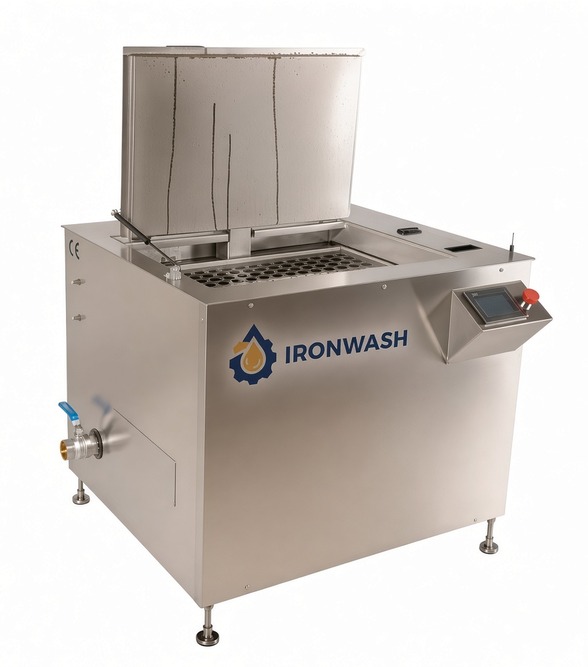
The Sonic range is industrial, not a benchtop jewellery bath. All models have heated tanks and a pneumatic platform that lowers the load in, agitates it and lifts it out.
Ultrasound runs at 28 or 40 kHz with sweep and digital frequency control. Pair a Sonic with a Rotor if you also clean large, oily parts.
Request a quote, or simply register your interest: it helps us plan the next shipment and costs you nothing.
Pre-wash oil and grease, then use a heated ultrasonic cycle with a detergent suited to the metal, followed by rinsing, blowing out and drying. Scrape or brush only what is left, taking care with gasket faces and aluminium.
Yes, dismantled injector parts and bodies are commonly cleaned ultrasonically because the bath reaches the fine passages. Follow the injector maker’s instructions and test the injectors on suitable equipment afterwards.
Yes. Carburettor bodies, jets and float bowls are typical ultrasonic jobs because varnish and deposits sit inside fine passages. Remove rubber parts and floats that should not be immersed first.
Ultrasonic cleaning is widely used on aluminium. Use a detergent made for aluminium and a suitable frequency and cycle time.
Choose by the largest batch and weight: the Sonic 160X has a 70 kg platform, the Sonic 160 takes 100 kg and the Sonic 310 takes 220 kg in a 930 × 560 × 390 mm useful basket.
Tell us what you clean and where the machine is going, and we will reply with an itemised quote. Not ready to buy? Tick "register interest" and we will keep you updated on availability and shipments. All enquiries are handled by email: you can also write to info@ironwash.africa.
Enter your email address to unlock the PDF download.