Home › Degreasing machines
Cleaning guide · oil and greaseOily and greasy parts are the everyday problem in workshops, plants and maintenance teams. This guide compares the ways to remove oil and grease from metal parts and explains how an industrial degreasing machine works.
Fresh oil runs off easily, but in service oil and grease mix with dust, metal fines and combustion by-products. Over time this turns into a sticky film or a hard crust. Cold water barely touches it, and wiping only spreads it. Removing it reliably takes three things working together: chemistry (a detergent or solvent that breaks the oil down), heat (which softens grease and speeds up the chemistry) and mechanical action (spray, brushing, agitation or ultrasound that carries the dirt away).
The classic parts-cleaner sink uses solvent or diesel and a brush. It dissolves oil well, but someone has to scrub each part, solvent fumes and skin contact need managing, the fluid is flammable, and the oil dissolves into the bath until it is saturated. Parts often come out with an oily film that has to be removed before painting, welding or assembly.
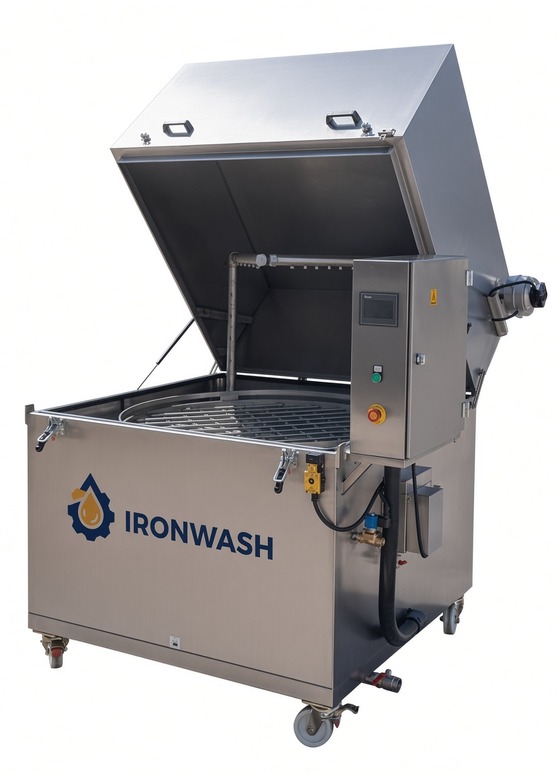
An aqueous (water-based) parts washer replaces solvent with heated water and a low concentration of detergent. In a rotary parts washer the parts sit in a basket inside a closed cabinet; the solution is heated, pumped through spray lines and sprayed over the parts while the basket turns. Heat, detergent and spray together lift oil and grease off every side, and the machine runs the cycle on its own.
The IronWash Rotor uses this principle: 9 kW or 15 kW heating with a 0–60 °C thermostat and weekly timer, a 0.9 kW wash pump moving 21 t/h through two spray lines, a disc oil separator that skims oil so the bath stays effective for longer, and AISI 304 stainless steel wherever the wash water touches. See Rotor rotary parts washers.
For parts where oil and grease are trapped in threads, holes and internal passages, an ultrasonic cleaner immerses the part in a heated detergent bath. Cavitation bubbles collapse against every wetted surface and lift the film from places a spray never reaches. The Sonic range adds a pneumatic platform that agitates the load, a recirculating 5-micron filter and oil decanting with surface sweep. See Sonic ultrasonic cleaners.
| Solvent / diesel tub | Hot-water rotary washer | Ultrasonic cleaner | |
|---|---|---|---|
| Labour | Hand scrubbing | Load, start, walk away | Load, start, walk away |
| Best for | Odd single parts | Heavy, greasy parts in batches | Intricate parts, passages, carbon |
| Cleaning medium | Solvent or diesel | Heated water-based detergent | Heated water-based detergent |
| Reaches internal passages | Partly | Partly | Yes, every wetted surface |
| Oil handling | Dissolves into the bath | Oil separator | Oil decanting and filtration |
Look at the largest and heaviest part, how many parts you clean in a week, how dirty they are and whether they have internal passages. Heavy oil and grease on engine blocks, gearbox casings, axles, housings and fixtures points to a rotary washer. Parts with passages, such as valve bodies, injectors and carburettors, point to an ultrasonic cleaner. Many workshops use both. Ask us and we will recommend a size based on your parts.
Request a quote, or simply register your interest: it helps us plan the next shipment and costs you nothing.
A machine that removes oil and grease from parts automatically, using heat, a detergent or solvent and mechanical action such as spraying, agitation or ultrasound. Rotary spray washers and ultrasonic cleaners are the most common industrial types.
For most oily workshop parts a heated water-based washer removes oil without flammable solvent, runs unattended and leaves no solvent film. Solvent still has niche uses, but for batch cleaning of greasy parts a hot-water washer is usually the more practical choice.
A water-based, low-foam parts-washer detergent in a low concentration, matched to the metals you clean. Aluminium needs a product that is safe for aluminium.
The Rotor thermostat is adjustable from 0 to 60 °C. The Sonic 160X thermostat runs from 0 to 80 °C.
Use an ultrasonic cleaner: the parts are immersed and cavitation cleans every wetted surface, including threads, blind holes and passages.
Tell us what you clean and where the machine is going, and we will reply with an itemised quote. Not ready to buy? Tick "register interest" and we will keep you updated on availability and shipments. All enquiries are handled by email: you can also write to info@ironwash.africa.
Enter your email address to unlock the PDF download.