Home › How to clean engine parts
Cleaning guide · engine partsBlocks, heads, crankshafts, sumps, injectors and brackets all arrive on the bench covered in oil, grease, sludge and carbon. Here is how workshops clean engine parts for a rebuild, inspection or reassembly, and when an automatic machine pays its way.
Cleaning is not cosmetic. A fitter cannot measure a bore, check a head for cracks or judge a bearing journal through a film of oil and dirt. Grit left in an oil gallery or bolt hole goes straight into the new bearings when the engine is started. And assembly paste, gaskets and sealants need clean, dry, oil-free surfaces to do their job. A good cleaning step is therefore part of the rebuild, not a chore before it.
The dirt on an engine is also a mix: soft oil and grease on the outside, baked-on sludge in the sump and valve cover, carbon on pistons, valves and combustion chambers, and fine grit in passages. No single brush or spray deals with all of it, which is why most serious workshops combine methods.
The traditional parts-washer sink, a tub of solvent or diesel with a pump and a brush, is cheap to start with and fine for the odd part. For engine work it has real limits: someone stands at the sink scrubbing every part, results depend on the person, solvent fumes and skin contact are a health concern, and diesel or solvent leaves an oily film that still has to be removed before assembly. Large parts such as blocks and heads barely fit.
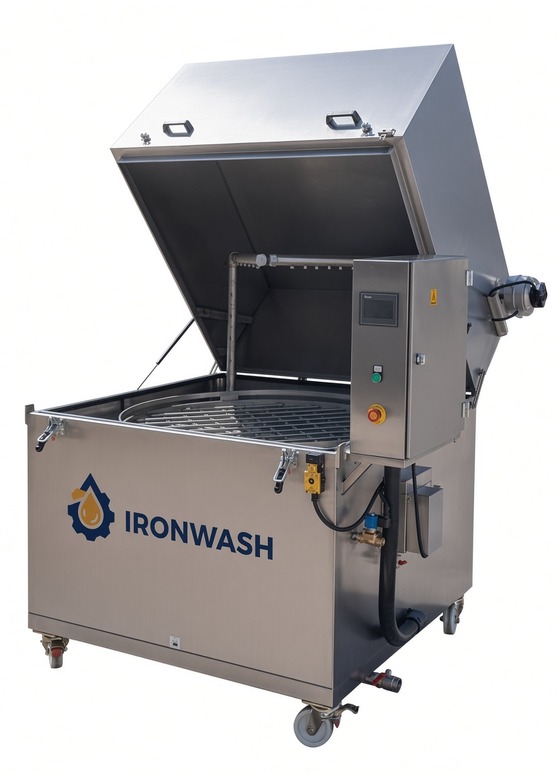
A rotary parts washer closes the parts in a cabinet, heats water-based detergent and sprays it from fixed spray lines while the basket turns. Every side of the part is hit by hot solution, and nobody has to stand over it. This is the workhorse for removing oil, grease and loose sludge from blocks, heads, crankshafts, sumps, covers, housings and brackets in batches.
An ultrasonic cleaner immerses the parts in a heated bath. Ultrasound creates tiny bubbles that collapse against every wetted surface (cavitation), scrubbing inside oil galleries, ports, threads and blind holes that a spray jet cannot reach. It suits injectors, carburettors, valve bodies, small precision parts and carbon-coated components.
Bead or media blasting removes paint, rust and hard deposits from some surfaces, but blast media must never be left in an engine, so parts are washed afterwards anyway. Blasting is a finishing or restoration step rather than a degreasing method.
Always match the detergent to the metal: aluminium heads and housings need a product that is safe for aluminium. Ask your chemical supplier for a water-based detergent made for the metals you clean.
Rotor rotary parts washers handle the heavy, greasy items: engine blocks, cylinder heads, crankshafts, sumps, flywheel housings and brackets. Baskets run from Ø740 × 450 mm and 150 kg (Rotor 800) through Ø940 × 500 mm and 300 kg (Rotor 1000) to Ø1140 × 600 mm and 400 kg (Rotor 1200). A thermostat (0–60 °C) and weekly heating timer mean the water is warm when the shift starts, and a disc oil separator skims oil off the bath.
Sonic ultrasonic cleaners handle the intricate parts: injectors, carburettors, valve bodies, oil coolers and anything with passages. Choose from 160 L or 310 L tanks with pneumatic platforms for 70, 100 or 220 kg, 28 or 40 kHz ultrasound with sweep, and a recirculating 5-micron filter. See the ultrasonic cleaner range.
Many engine shops use both: degrease in the Rotor, finish in the Sonic.
Request a quote, or simply register your interest: it helps us plan the next shipment and costs you nothing.
Degrease the large parts in a heated, water-based spray washer, clean intricate parts and passages in an ultrasonic tank, blow out galleries with compressed air, then dry the parts and protect bare iron. Use a detergent that is safe for the metals involved, especially aluminium.
Many workshops do, but diesel leaves an oily film, is a fire and skin-contact risk and still needs to be washed off before assembly. A heated water-based parts washer removes the oil instead of spreading it.
It depends on the block and the basket. Rotor baskets are Ø740 × 450 mm (150 kg), Ø940 × 500 mm (300 kg) and Ø1140 × 600 mm (400 kg); Rotor 1400 specifications are on request. Send us the dimensions and weight of your largest part and we will confirm the fit.
Ultrasonic cleaning is widely used on aluminium parts. Use a detergent made for aluminium and the right frequency and cycle time; the Sonic range offers 28 or 40 kHz with sweep and digital frequency control.
Request a quote with the form on this page. Tell us what you clean, the size and weight of your largest part and where the machine is going, and we will reply by email with an itemised quote.
Tell us what you clean and where the machine is going, and we will reply with an itemised quote. Not ready to buy? Tick "register interest" and we will keep you updated on availability and shipments. All enquiries are handled by email: you can also write to info@ironwash.africa.
Enter your email address to unlock the PDF download.